AI-In-a-Box in Action: Three Enterprise Use Cases for Secure AI
In this article, we look at three real-world use cases that show how AI-In-a-Box makes secure, enterprise-grade AI possible.
What if you could avoid sending your confidential and proprietary information to AI?
Instead bring AI to your confidential and proprietary information?
This is the promise of AI-in-a-Box.
This role inversion leads to rapid, secure and worry free adoption of AI without incurring risks of information exposure.
After spending time at WAICF, one thing became very clear to us: the way people talk about AI is changing. A year ago, most discussions were about performance, new models, and what AI could do. This time, almost every conversation came back to the same question: how can companies adopt AI without losing control of their data?
Between keynote talks and informal chats, we kept hearing the same concerns about privacy, compliance, internal governance, and the fear of sending sensitive information outside the organization. The ambition to move fast with AI is still there, now trust has become part of the equation.
This is the kind of challenge AI-In-a-Box was built for.
Let’s walk through three real use cases where it proves its value.
1. Secure Internal Assistants
Today’s Problem Companies face
Your company already has the answers. Somewhere in a shared drive, a forgotten email thread, or a document no one can quite remember the name of. So, the knowledge exists.
The problem that we are facing is not about having the information, it’s that your people are losing hours every week just trying to find it.
AI assistants promise to fix this, but cloud-based AI raises one big question: can you really send confidential documents to an external platform?
For many enterprises, the answer is no.
Why the Tools You Have Weren't Built for This
Existing AI solutions often depend on external APIs and opaque data handling processes. That creates friction with security teams and leaves organizations asking tough questions:
Who processes our internal data?
Is anything retained or reused?
Can we meet compliance standards?
Will our proprietary and often secret information become public?
Because of these concerns, many companies either avoid AI assistants entirely or deploy watered-down versions that never reach their full potential. They also rely on expensive preprocess to redact sensitive information which is error prone and time consuming.
How AI-In-a-Box Changes the Game
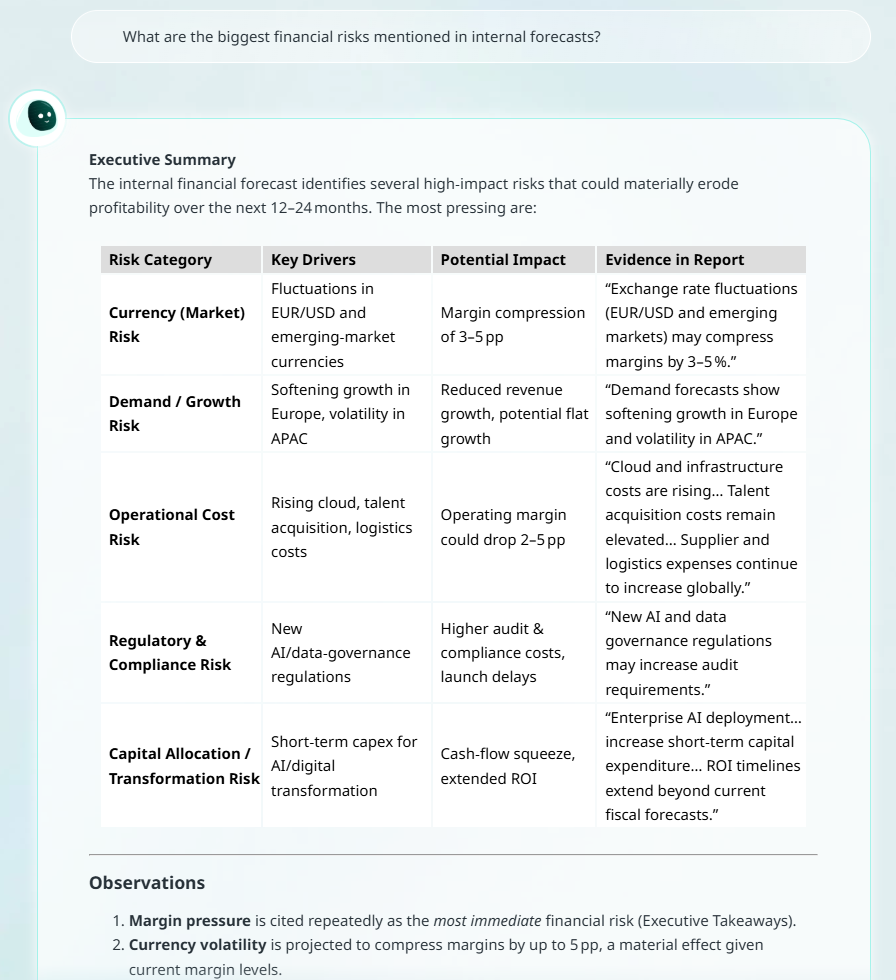
With AI-In-a-Box, the assistant lives inside your infrastructure, not somewhere in the cloud.
Local model inference, on-site vector databases, and role-based access controls allow teams to safely interact with internal knowledge without risking exposure. The result is an AI assistant employees can actually trust. One that delivers instant, contextual answers while keeping sensitive information fully contained. This is peace of mind for CIOs.
It’s like giving every employee a private expert that already knows your organization without ever leaving your network.
2. Patents & R&D Protection
The Innovation Dilemma
AI could speed up research and patent work, but early R&D ideas are sensitive. Until people know where their data goes, hesitation around AI is justified.
Why Cloud AI Feels Risky for Researchers
Even when providers promise privacy, companies still face uncertainty:
External processing means reduced control.
Training pipelines are often unclear.
Auditability can be limited.
Security teams may block AI usage entirely.
The result: researchers either work slower without AI or use unofficial tools that bypass governance. We can all agree that neither is ideal.
AI-In-a-Box as a Safe Innovation Engine
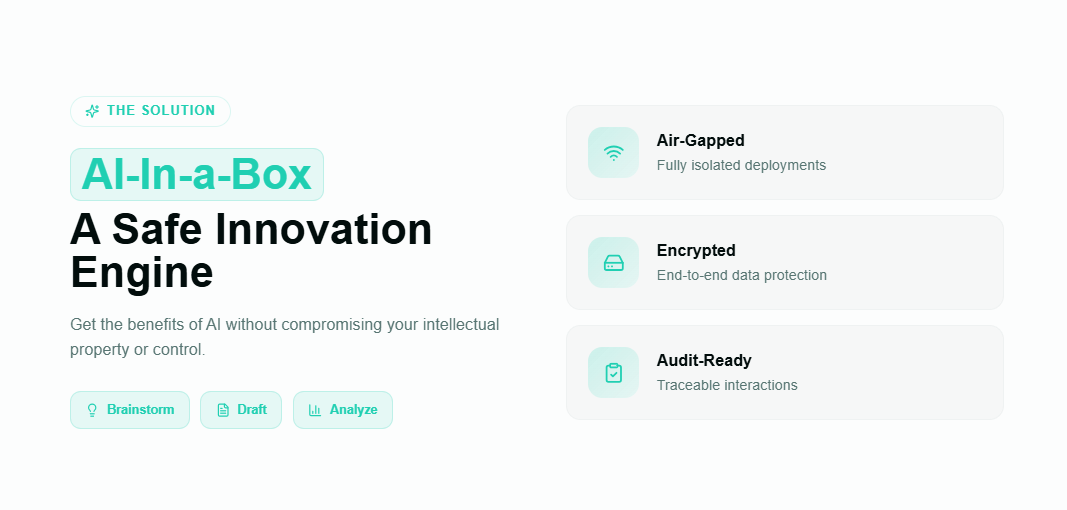
AI-In-a-Box gives R&D teams the best of both: powerful AI assistance without sacrificing intellectual property protection.
Air-gapped deployments, encrypted storage, and audit-ready logs ensure every interaction stays internal and traceable. Teams can brainstorm, draft, and analyze ideas confidently, knowing their innovations remain fully under their control.
3. Unlimited Code Generation
The Developer Reality
Engineering teams love AI coding assistants, until they hit token limits, context restrictions, or privacy concerns. Large repositories don’t fit neatly into cloud prompts, and many organizations are hesitant to expose proprietary codebases to external systems.
Developers want AI that understands their entire environment, not just fragments of it.
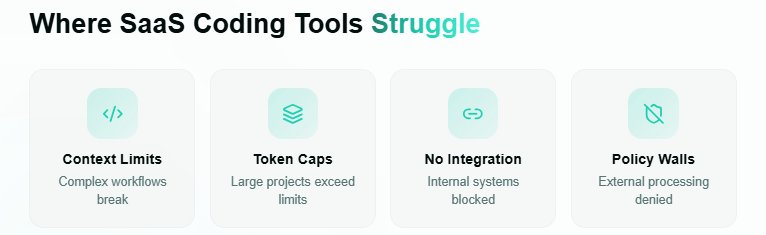
Where SaaS Coding Tools Struggle
Most cloud-based solutions run into predictable issues:
Limited context windows break complex workflows.
Large projects exceed token limits.
Integration with internal systems is restricted.
Security policies block external code processing.
What Makes AI-In-a-Box Different
Instead of working in small snippets, the model can understand entire repositories. It connects directly to internal tools and runs on-site, so there are no token limits and sensitive data stays secure.
Why AI-In-a-Box Matters
Across all three use cases, one theme keeps coming up: For some companies it’s not enough to just use AI, they need one that they can trust.
AI-In-a-Box represents a shift away from experimental, cloud-dependent tools toward enterprise-grade intelligence that lives where your data already resides.
It allows organizations to:
Deploy AI without risking data exfiltration.
Meet compliance and governance requirements.
Accelerate innovation cycles safely.
Empower teams with scalable, private AI capabilities.
In many ways, it’s the missing piece between AI ambition and real-world deployment.
We are convinced that the future of enterprise AI is not about smarter models, but about smarter architecture. And sometimes, the most powerful innovation isn’t sending your data to AI… it’s bringing AI to your data.
Learn more about