See what our test case generator can do with your specs · No signup required
TCG Test Case Generator
From standards and specifications to structured, traceable, and automation-ready tests.
TCG is an AI-powered application from Understand Tech designed to accelerate the path from technical specification to executable testing assets. It ingests standards and technical documents, extracts requirements with traceability, generates test cases in a controlled format, analyzes quality and coverage, and can optionally produce executable scripts aligned with engineering conventions.
What TCG is, and the bottleneck it removes.
TCG is a specialized application for teams working with standards, specifications, and requirement-heavy documents. Instead of manually turning dense source material into test suites, teams can use TCG to generate structured test artifacts grounded in the specification, with measurable quality signals and review support built in.
- Manual requirement interpretation is slow
- Coverage gaps are hard to detect early
- Test consistency varies across authors
- Maintenance becomes painful when specs evolve
- Moving from test case to script often requires another manual step
Delta Generation
When a specification gets updated, you don't want to regenerate every test case from scratch. TCG's Delta Generation detects exactly what changed between two versions and updates only the impacted test cases.
Not sure what that means in practice? Listen to Naama, our CEO, walk you through it in under a minute.
How TCG works
A structured pipeline from specification to automation-ready output.
Upload specification
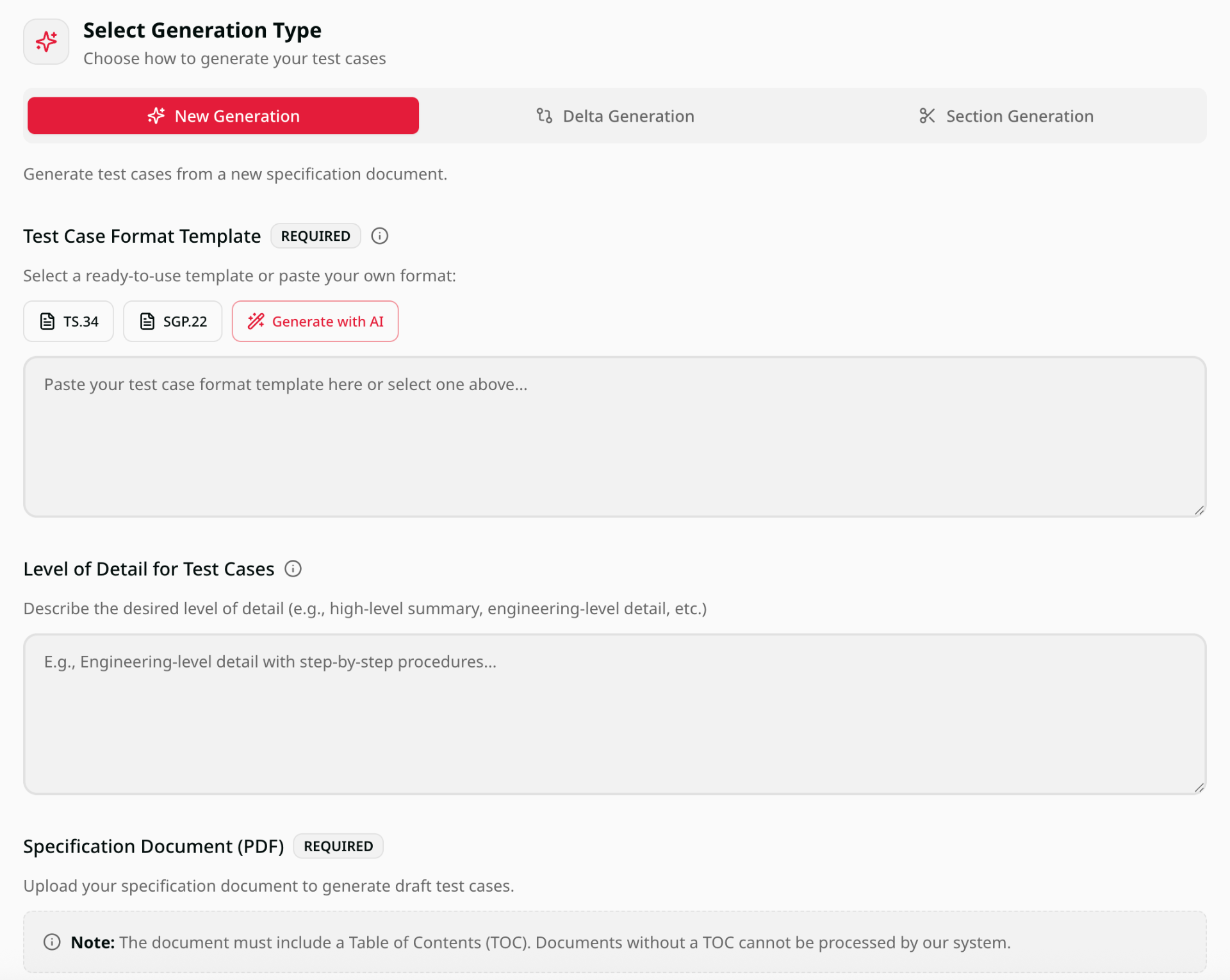
TCG starts from the source material, typically a technical specification in PDF or related formats. The system processes the document structure, including sections, tables, figures, and annexes, rather than relying only on plain-text extraction.
Extract requirements
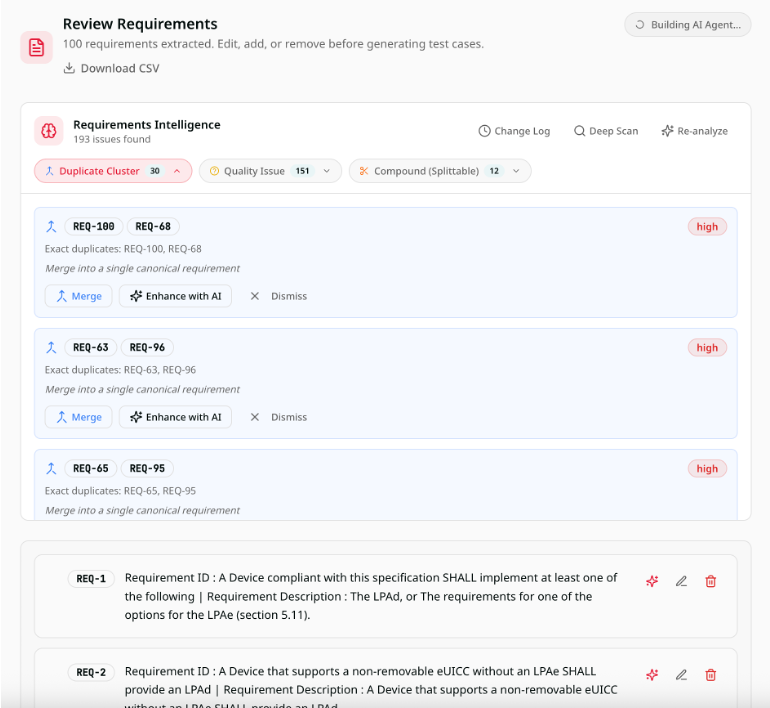
The application extracts requirements with IDs, metadata, references, modality signals such as MUST, SHALL, or SHOULD, and traceability back to source sections. It also captures relevant surrounding context such as definitions, prerequisites, and exceptions.
Generate test cases
Using extracted requirements, source references, metadata, and a user-defined test format, TCG generates structured test cases aligned with the requested template and wording style. It can also use curated knowledge base context to improve grounding.
Analyze quality and fixability
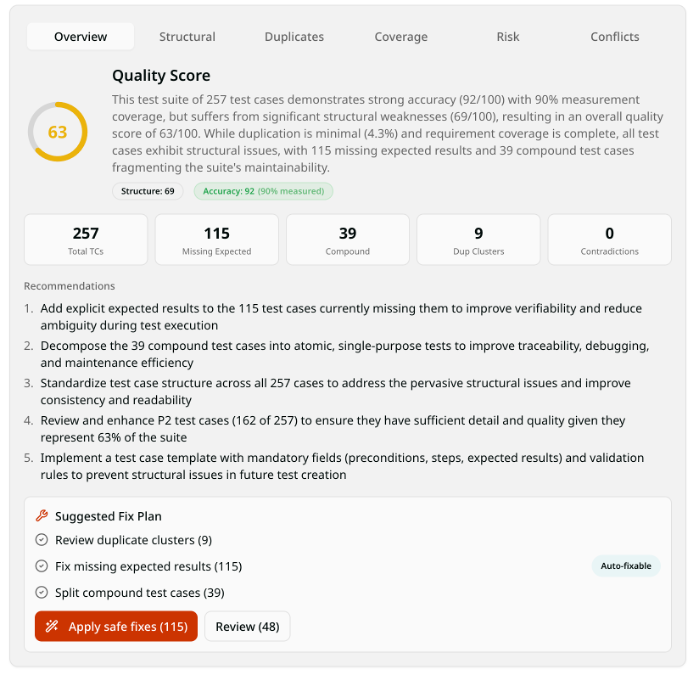
Generated results are analyzed for structure and AI quality. TCG identifies issues such as duplicates, missing validation, weak traceability, or low-confidence outputs, and produces a guided fix plan showing what is safe to apply automatically versus what should be reviewed.
Generate scripts and export
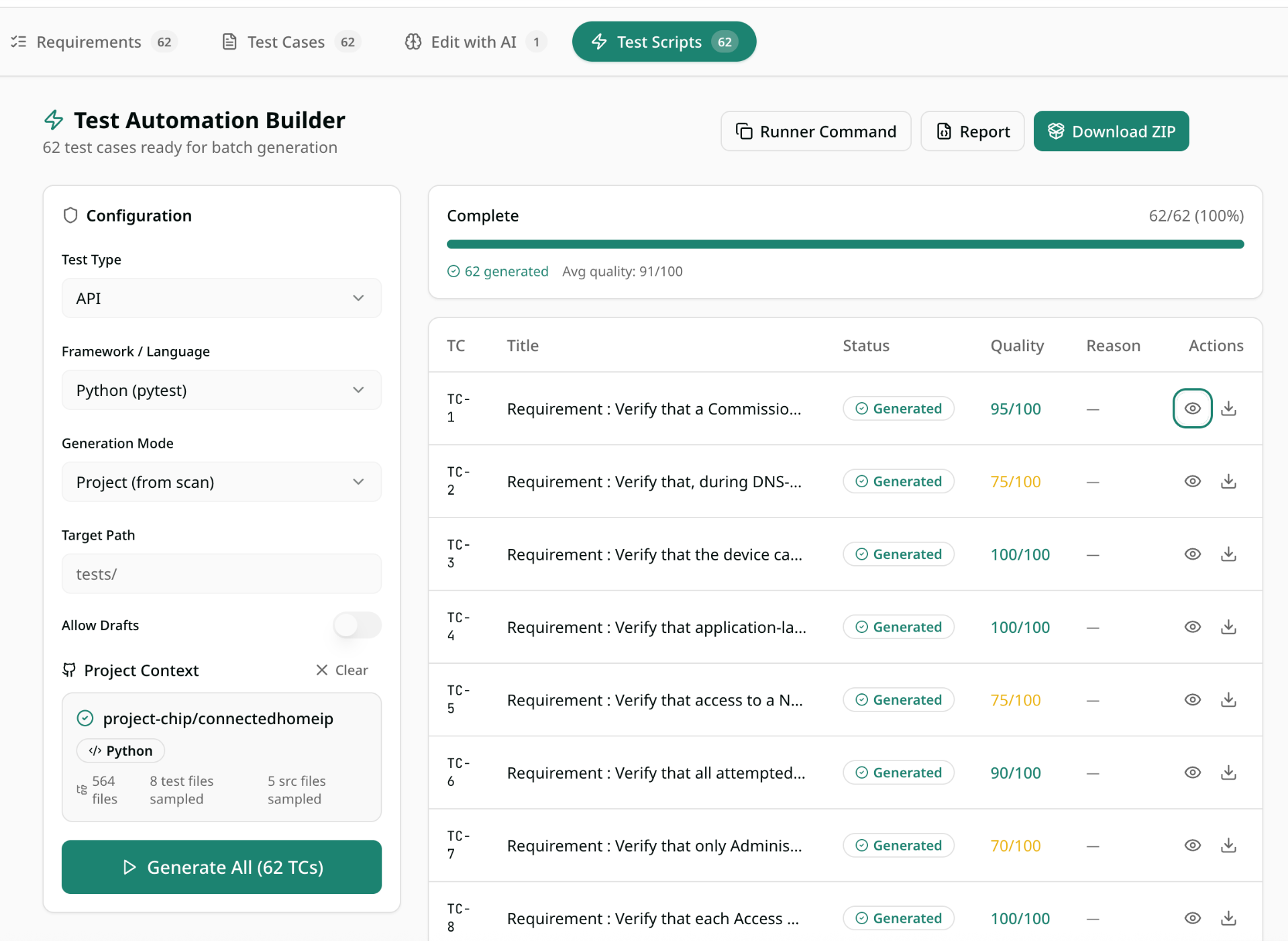
Where needed, TCG can transform approved test cases into executable scripts using generation profiles, framework selection, repo-aware conventions, and preflight checks. Outputs can be exported as automation-ready bundles.
Key capabilities
Section-aware requirement extraction
Parses specifications into a structured hierarchy and extracts normalized requirements with IDs, metadata, modality, references, and traceability links.
Template-locked test generation
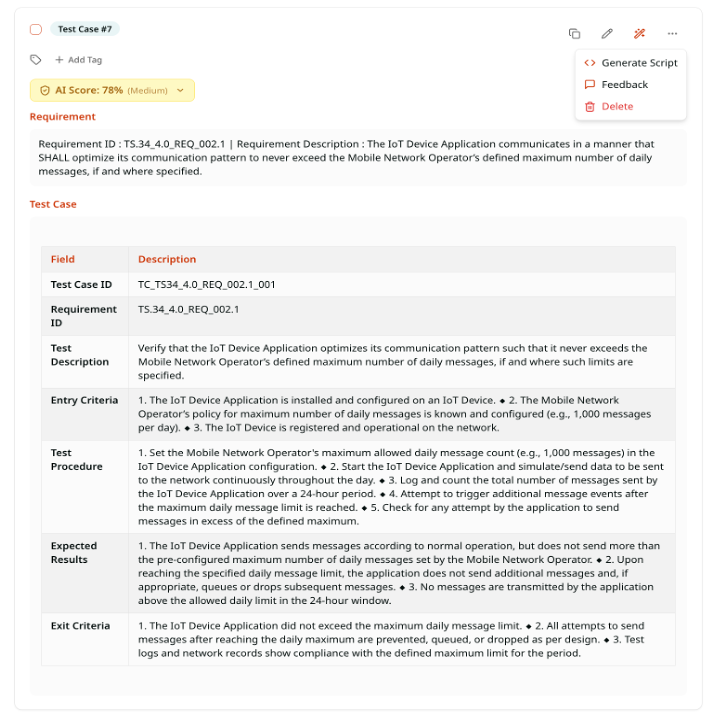
Test cases are generated in the exact user-defined format, including expected structure, fields, numbering, and wording conventions.
Hybrid quality assurance
Combines deterministic checks with AI review. Deterministic checks address structure, duplicates, modality consistency, while LLM review identifies ambiguity and weak intent alignment.
Measurable AI quality signals
Produces confidence-related metrics per test case, including signals around faithfulness, intent match, and contextual relevance.
Coverage and readiness visibility
Provides visibility into requirement and section coverage, helping teams identify missing, weak, or redundant testing areas.
Automation-ready export
Approved outputs can be converted into executable scripts using framework-aware generation and project-aligned conventions, with preflight checks.
TCG toolbox
Short videos showing what TCG does in practice, from requirements to generated tests.
Engineered for precision workflows
Standards-grade pipeline
TCG uses a pipeline approach rather than a single prompt-response pattern. It builds a structured understanding of the source specification, extracts normalized requirements, generates test cases under template and context constraints, and evaluates output quality through both deterministic checks and AI-based review signals.
For teams working on standards conformance, certification-oriented testing, or requirement-heavy validation programs, TCG preserves engineering discipline while reducing manual authoring and maintenance effort.
From test cases to executable scripts
TCG does not stop at test case drafting. For teams that want to accelerate automation, the application can generate executable scripts using selected frameworks and generation profiles aligned with project conventions.
Generation accounts for repository patterns, allowed imports, helper usage, and enterprise constraints. Preflight checks help prevent or flag scripts derived from low-trust or insufficiently validated test cases.
Readiness through traceability and coverage
TCG supports the elements reviewers typically expect from a "ready" conformance suite.
Built for complex specs
Teams working with requirement-heavy technical documentation.
Why teams use TCG
Reduce manual authoring effort
AI generates a strong first draft of the test suite from the specification, reducing repetitive manual drafting work.
Improve consistency and readability
Using a standard template and generation controls helps create more uniform outputs across teams and document sets.
Reduce maintenance overhead
When requirements evolve, teams can update or regenerate instead of rewriting large parts of the suite from scratch.
Speed up review
Quality signals, traceability, and guided fixes help reviewers focus attention where it is most needed.
Accelerate automation
Optional script generation reduces the manual step between approved test case and executable test asset.
TCG questions, answered.
What TCG does, how it keeps tests traceable, and where it can run.
Key facts
- TCG (Test Case Generator) turns technical specifications into structured, traceable test cases and automation-ready scripts.
- It extracts requirements with IDs, metadata, modality signals (MUST, SHALL, SHOULD), and traceability back to the source section.
- Test cases are generated in the customer's own template, with the required fields, numbering, and wording conventions.
- Quality analysis combines deterministic checks with AI review and produces a guided fix plan per test case.
- Approved test cases can be exported as executable scripts with framework-aware generation and preflight checks.
- TCG was co-built with GSMA and is used by standards organizations, conformance and certification teams, and QA and validation teams.
- TCG deploys as SaaS, in a private cloud, or fully air-gapped on-premise via AI-in-a-Box.
- A free trial is available at tcg.understand.tech with no signup required.